Monday, February 11, 2013

Learning the Basics


Learning the Basics

 B T :Dipak Mondal  :Edition: February 2013
Tips to know your financial literacy quotient

Knowledge can make all the difference between financial success and failure. For instance, what happens if a person, the family's sole bread-winner, buys insurance in the name of his wife and children instead of himself? If he were to die, his family would not get a penny from the insurance company.

Every time such cases of imprudence are highlighted, the lack of understanding of financial products among people comes to the fore.

Even if the reason for the wrong choice is mis-selling by intermediaries, investors cannot put the entire blame on others, as a part of the problem is their reluctance to know about their finances or financial products, in short, their lack of financial literacy.

Here is what a person must know and do if he wants to keep himself financially safe and sound.

Keep track of cash flow: 
With multiple credit cards, there is always a chance of spending much more than you earn. There is high likelihood of falling into a debt trap if you do not assess your income and expenses. Knowing your cash flow is the first step towards financial literacy.

Basically, being financially literate means knowing how much money you have and how much you need," says Anil Rego, chief executive officer and founder, Right Illustration: PRAGATI Horizons, a financial advisory firm.

"Financial planning is not only about investment planning, it's about money management as well," says Jitendra Solanki, a New Delhibased certified financial planner.


Maintaining a note book with income and expenses entered into different columns is an age-old way of keeping tabs on cash flow. If you are not alien to computers and internet, you can do so with the help of online personal finance applications such as myuniverse.co.in, perfios.com and arthyantra.com which are available for free.

Charting out financial goals: 
Setting financial goals is the second-most important indicator of your being financially evolved.

In the absence of clear financial goals, investments become just a tax-saving exercise or thrill-seeking speculative stock trades. Knowing how much to invest and for which goals helps you plan better.
Maintaining a note book with income and expenses entered into different columns is an age-old way of keeping tabs on cash flow. If you are not alien to computers and internet, you can do so with the help of online personal finance applications such as myuniverse.co.in, perfios.com and arthyantra.com which are available for free.

Charting out financial goals: 
Setting financial goals is the second-most important indicator of your being financially evolved.

In the absence of clear financial goals, investments become just a tax-saving exercise or thrill-seeking speculative stock trades. Knowing how much to invest and for which goals helps you plan better.


"Set financial goals, save for them and make good investment decisions," says Arup Mukherjee, assistant vice-president, strategic business unit education, National Stock Exchange.

If you know how much you will need for, say, your child's education, in 10 years, you can invest regularly for the goal. The investment will depend on the product you invest in. In fixed deposits, your post-tax return will be 6-8%. In equities, you can expect to earn 10-12% a year over the next 10 years.

To know how much you need to invest, you can use online calculators on websites of mutual funds, insurance companies and banks.

Know the financial products: 
A person buys just Life Insurance Corporation's traditional schemes as they serve his tax-saving, insurance as well as investment needs. He is, however, unaware of the fact that the schemes will give him just 6-7% return a year, which may not be enough to meet all long-term financial goals.

Choosing financial products that suit you is important . "Understand the financial products you may need throughout your life, including bank accounts, mortgages, retirement savings plans and basic instruments such as stocks, bonds and mutual funds," says Ambarish Datta, managing director and chief executive officer, BSE Institute.

Equally important are the benefits and risks associated with a product. Equities have volatility risk, bonds have interest-rate risk (bond prices fall as interest rates rise), fixed deposits have default risk (the borrower may be unable to pay back), while real estate has liquidity risks.

"Understanding the risks and benefits of a financial product by talking to the agent or conducting basic research is an imperative before taking an investment decision," says Bimal Gandhi, chairman, Ameriprise India.


"Most of the times, investors look at just the past returns, but it is equally important to understand the risks the product carries," says Rajesh Kothari, managing director, AlfAccurate Advisors.

Importance of asset allocation: 
Don't put all the eggs in one basket. You should allocate money to different assets-equity, debt, fixed deposits, gold and real estate- based on your needs, risk-taking ability and age. Diversification limits losses when one or more asset is not doing well.

"Investors must understand the importance of asset allocation. They must invest in different assets whose benefits and risks they understand," says Deepak Kumar Chatterjee, managing director and CEO, SBI Mutual Fund.

Know the charges:
Issuers and sellers of financial products charge different fees that affect the cost of purchase and hence long-term returns. It is, therefore, essential to know how much you are being charged.

Banks charge for most services such as online money transfer, loans and issuing demand. These can have a huge impact on your monetary outgo.

Similarly, investment products such as mutual funds, insurance and unit-linked insurance policies come with multiple charges such as fund management fee, mortality fee and distributor's fee. Buying shares requires payment of brokerage and demat charges. Real estate involves brokerage and registration charges while buying gold involves making charges and taxes.

Tax implications: 
Tax can take away a big chunk of your investment and salary if you do not plan well. Other than the salary, returns from investments-interest, capital gains and dividends-are also liable to tax. Then there are service tax, stamp duty and securities transaction tax (STT).

While you cannot escape some such as service tax and STT, you can lower the tax on capital gains or interest earned by tweaking your portfolio.

All you need to know is the applicability (or non-applicability) of tax on different financial products.

Know the basic financial math: 
This can be a little tough, but when it comes to managing your money, you can go that extra mile. All you require is understanding of basic financial mathematics such as compound interest and Rule of 72.

You may have a mental block when it comes to numbers, but with all kinds of calculators and financial applications available online, mastering a few basic formulae is not tough.

"Many people understand the benefits of compounding and the difference between simple and compound interest. The reason is simple- they understand banking better than, say, a mutual fund," says Chatterjee of SBI Mutual Fund.

ASK THE RIGHT QUESTIONS
If you know the things mentioned earlier, it helps if you ask the right questions about the product you are being sold. This way there is less chance of you being sold a product that does not suit your needs.

So, if an insurance agent tells you about a "savings plan" with "free" insurance, ask about the different charges that you will have to pay and the returns that can be expected and compare them with what other products are offering.

Financial literacy is a vast subject and the more you know the better it is. However, you can be a successful investor without being a financial wizard. All you have to do is get the basics right.

Sunday, February 10, 2013

"The Tatas are inspirational; I had to write the full story": Harish Bhat news

Harish Bhat, Managing Director of Tata Global Beverages
Excerpt from Tata Log Feb 10,2013

Harish Bhat, Managing Director, Tata Global Beverages, discusses his book Tata Log, comprising eight stories about various Tata companies, withShweta Amit.


You are a regular columnist for Mint and now an author. What propelled you to write this book?
There are two things that propelled me to write this book, Firstly I have worked 25 years with the Tata Group and have been greatly inspired by many stories that I have seen of the Tata Group - some stories I have participated in and some that I have seen as a member of the Tata Group, but from outside its organisations.

So for instance, the Tanishq story I have been a part of. But other stories like Okhamandal or Tata Indica, I have seen from outside and admired greatly.

So I thought to myself that there are many inspiring stories from the Tata Group which have not really been told in a manner that reaches out to a large number of people.

As I said if these stories are written well, it can inspire many youngsters, young managers and entrepreneurs to change their dreams and achieve what the Tata Group has achieved over the last several years. That was the first drive to write this book.


The second reason is my passion for writing. If I were not a manager, I would be a writer. I love the written word and expressions and that's why I keep writing for newspapers and other publications. So writing this book came from the confidence of those two drives - the inspiring stories seen within the Tata Group and my passion for writing.

How different is it to author a book from writing a column?

Authoring a book requires you to live the book day in and day out. Writing a column is two to three hours of work. It's about structuring your thoughts on a specific topic and putting it down. Once you file your column, it's out of your way. And you don't think too much about it anymore. Writing a column is very limited in terms of the time and energy it demands.
Authoring a book requires a huge amount of intellectual energy and dedication. You have to be very clear about the theme of the book. Every story has to be researched very well so that it's authentic. The book itself has to show in a manner that it's very enjoyable to read. So both are different as say - you can prepare a small snack which will take you 10 minutes to prepare or you could prepare a five course Indian meal.
I would also think that in authoring a book it's important to bear in mind that it should be readable. Many books that are bought are not read completely. One of my objectives in writing this book was that not only should it be enjoyable and engaging but readers should be able to pick it up at an airport or a bookstore and in the course of a two to three hour flight they should be able to complete reading the book.
Also you cannot write a book when you are in midst of day-to-day operational work of a company as a manager. So I took a sabbatical from work for three months – April to June. I sat down and spent most of my time at the location where the various stories are based. I think these three months helped me authoring this one.

How different is this book from the clinical case studies one is accustomed to reading in several B-schools as a part of their curriculum?

I would call these case stories, which are different from case studies. A case study basically illustrates a particular facet of management. It's filled with data, statistics and events. It's written from a very rational point of view. It engages the head completely.
A case story of the 'Tata Log' kind contains on the other hand is meant to inspire. And you cannot inspire people with just facts, annexures, financial figures or tables. Inspiring people is about feeling of the head and heart. A great movie for instance appeals to both the head and the heart. It has a great story and also a lot of emotions in it. This book presents those stories in a manner that appeals to both the head and heart. The stories have a lot of rational fact to them and also a lot of emotion.
These are just not the stories of companies but of people within those companies, their dreams and ambitions, the failure they went through and how they recouped from those failures. So for instance if you read the story of Tata Indica, you will read the story of the designer of Indica. These stories are very rich in emotion and people, which typically you will not find in an IIM case study. The stories in 'Tata Log' appeal both to the left brain and right brain. Whereas a lot of these case studies found in the management institutes primarily appeal to the logical left brain.
When Tata Indica was first talked about being developed and launched, there was an element of cynicism in the response. How does one stick to their decision to go confidently ahead with the plan despite these unfavourable reactions?
If you look at page 48 in the book, there is a section there called the heart of courage which says, 'I often wonder: Where does such great courage come from? Does it come from deep within outstanding individuals and teams, as they pursue their passions and drams? Does it emerge from a very strong sense of duty to the country? Or does it simply come from fearlessness, which often lends itself generously to a noble purpose?'
If you look at Tata Indica, there were two things. First and foremost, as Ratan Tata has said he had utmost faith in Telco engineers. They were the ones who produced the Tata Safari and Sumo. He knew these were the engineers who created brilliant vehicles. That faith in the Tata Motors engineers was the source in confidently sticking to this decision to go ahead.
The second was a strong sense of duty to what was thought a big milestone step ahead for the country. And that the Tata Group has done right from the beginning.
Take for instance the Taj Mahal hotel in Mumbai. The Tata Group has always gone where no one else has ever gone before. And that strong pioneering urge which is always a sense of risk has been at the heart of the Tata Group in the last one and a half decades. This pioneering urge has made Tata go ahead and do things which no one has ever done before, even though there was a lot of cynicism.
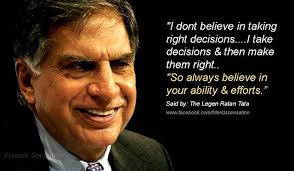
Ratan Tata is quoted in my book as saying, ''It is important, particularly for the younger people in India, to believe in what we are doing and that we can do much more. They need to believe in and recognize the potential of their own capabilities.''
So you have to believe in yourself and be restless. That's what keeps a pioneer going. A pioneer always believes in oneself. When Christopher Columbus left the shores of Europe and sailed to find a new land, he believed in himself that he could do that. In a similar way, when Ratan Tata spoke of creating the Indica, he was speaking as a pioneer with a lot of belief in self, the company and the team. It was very inspiring and a pathbreaking moment for India. India was a country which had created a space craft, nuclear weapons and atomic bombs on its own but we did not have a car of our own which had been created in the country. So it was a milestone. Also for a country, a car is also its symbol.
It was overwhelming to read about your initiative at Okhamandal. You believe that you take a lot from the society so it's important to give back as well. How important is CSR according to you? Should this be an initiative taken by every corporate house as a purposive measure-one of the 4 Ps mentioned in your book?

I think every corporate house has a commitment to the community and it's very important because we live as a part of that community. And therefore when I speak about purposiveness as one of the Ps of the Tata Group in the book, purposiveness is about adding back to that community and country. Being driven by economic objectives alone, in my view makes an organization very narrow minded. An organization has to improve the quality of life in the community in which it's located.
And as Ratan Tata says, ''My view is that our expression of social responsibility cannot be measured in terms of profit or cost. It cannot be quantified in the language of sales or turnover. I would like to think this is the best of what Tata companies stand for.''
I think corporates are a very large part of countries and communities today. And therefore they have an important role to play in healing those wounds and doing the work and in making the communities they are a part of, much better places to live in.
Therefore to me, purposiveness is critical. Fortunately for us in the Tata Group, purposiveness has been a strong hallmark from the time the group was founded until today.
And The Whale Shark story in Okhamandal for instance demonstrates that. This was not going to add to the profits of Tata Chemicals but Tata Chemicals did it out of a sense of purpose because it believed that it was something critical and this was an endangered species which had to be saved. It was an important objective as it was a part of the eco system.
With regards to what happened with Tata Finance, how does one cope up with such unforeseen tribulations and ensure that the brand equity is not tarnished?

That's an important question and the reason why I have included Tata finance story in my book is to essentially make the point that no organisation is perfect. And I have actually said that the fourth P in my book as 'not perfect'. Since no organisation is perfect, we have to accept that there will be mistakes time to time.
Things will not always be one hundred per cent correct. There will be aberrations which happen. But it's very important that those aberrations should not be brushed under the carpet. They have to be addressed and dealt with and organisations have to do what is right to address those aberrations.
It was a huge loss because a fraud had been committed in the Tata Finance episode. There were two things which Tata Group did. The first thing it did was to reassure every investor and depositor that they will not lose a single penny. That was critical.
The second it did was to also pursue the culprits and brought them to justice. That also was not brushed under the carpet. And both these things were done very transparently and quickly. Perhaps one can say an error had occurred and the error should not have occurred in the first place. But that's the point I make about organisations not being perfect.
Sometimes as Indians we tend to put organisations and people on a pedestal. For us Mahatma Gandhi is perfect and he can do no wrong. For some other people, somebody else may be perfect. For many Indians, the Tata Group is a symbol of perfection.
Many people put their idols be it anyone, on a pedestal and tend to worship them. An organisation comprises of human beings. Human beings will be human beings and we all know nobody is perfect. And therefore errors will happen. However, responding to those errors in a very transparent, upright manner is what I think organisations need to do. The Tata Group responds to imperfections. They introspect and take the action required to deal with those imperfections.
That is why I have said that the Tata Group not being a perfect organisation, but deals with the imperfections while enhancing the other 3 Ps. You cannot let the imperfections take over the pioneering, purposive and principled factor. This has been the hallmark of our organisation.

The Tatas are known for their principled stance - another of the 4 Ps mentioned in your book. How does one retain success and at the same time not compromise on principles and ethics? Do you think Business and ethics go hand in hand?

It is truly very challenging in today's world. But I think the Tata Group over 150 years have demonstrated that it's possible to do business in a principled and ethical manner. What creates success for an organization? It is the pioneering spirit of creating a new brand that creates success.
Moving into a new product category and putting in place a new strategy to win over consumers creates success as you have seen from the Tanishq and Tetley example. Creating an innovative new product, whether it's the Tata Indica or Tata Swatch, creates success. So, creating success has so many factors to it.
In India we always tend to taint a large part of the country saying it is corrupt and there is a lot of corruption going around in India. But groups like the Tatas have shown that it is possible to create huge success by focussing on the pioneering and the purposive urge. Those are the urges that create wealth.
If you look at R M Lala's book, The Creation of Wealth, it talks about the creation of new businesses and products. It talks about a creation of a steel factory in the jungles of Eastern India, creation of a chemical unit in the semi-arid Okhamandal region of India and how Tata motors was created out of nothing at all.
According to me these are two very different dimensions. Creating success needs new thinking, new dimensions, vision and strategy and it is possible for all this to be done in a manner which is quite ethical provided you stick to those principles at all times and do not deviate - because even the slightest deviation often leads to a snowballing effect. That is something you should not tolerate if you wish to be a principled organisation.

Referring to the Tanishq episode, how difficult is it to win the trust or faith of the consumers? Do you think an aggressive marketing campaign and constant innovation in the jewellery sector plays a vital role?

In the jewellery market, there was a large segment of the jewellery industry which was taking women for a ride. The jewellers would say the jewellery was a 22 carat but it will actually provide lower than that. And they were therefore misusing the trust the family had in them. Typically the families had their own family jewellers. I am not saying all of them, but many jewellers were exploiting the trust.
Tanishq first and foremost said that when we say its 22 carats it will be 22 carats. Second they also introduced the carat meter on which the jewellery could actually be tested out. It was a scientific instrument and not available to consumers before that. So the trust came really from delivering to consumers what was promised. Tanishq has stuck to the platform of purity for so many years now, thereby reemphasising and re-establishing the trust with consumers.
Of course an aggressive marketing campaign is essential because you have to communicate this to the consumers. And constant innovation is essential because women don't buy jewellery just to keep it in their locker. Women also buy jewellery to wear it's a source of adornment for them. They like beautiful jewellery which makes them look and feel beautiful. Constant innovation in that case becomes critical and Tanishq did that and continues to do that.
To quote Desai, ''Tanishq must segment the jewellery market based on designs and price points. It must go back to the design concept as a differentiator. A work of art is known by its concept, and jewellery is such an expansive art form. Look at what Faberge did with a blooming egg!''
Therefore, constant innovation and designing plays a vital role as trust alone will not suffice.

The SCIP has benefitted many women who have restarted their career after a hiatus. How easy is it for them to get back to their second innings? Do you think that break for few years will come in the way of their career growth in the long run? 

While writing that story I spoke to several women who have benefitted from SCIP (Second Career Internship Programme for Women). And I have highlighted two of those stories in my book.
When you take a break and try to come back, one of the things I sensed from each of the women I spoke to was the fact that they needed confidence to get back into their career, because the break for those few years will make them lose their confidence.
What the SCIP programme does is provide a good bridge back by providing a 6 month to one year project work. The programme gives them a good meaty senior role and assignment. When they work on it for a definite number of months, that confidence comes back.
In whatever career we are, be it sportspersons, film actors, if you don't do what you are good at for a long time, it certainly takes away your confidence. And when you get back to what you were doing, you need someone to hold your hand for a little bit of time so that the confidence builds back in you. That's what the SCIP does.
Many of the SCIP trainees have gone into senior roles in organisations now. Women today are playing senior roles in the industry despite having taken breaks in their career. I personally have known women who have come back after maternity breaks and moved up significantly in their career. I personally think it is a challenge.
If you look at the statistics quoted in my chapter, as far as women are concerned a lot of them drop out of the work force. Only 22 per cent of women graduates enter the workforce.
Out of that 22 per cent only 52 per cent of the junior levels make it to the middle level management. Many talented woman drop out of the work force and never return. If you look at directors in companies, in BSE index, out of 1112 directors only 59 are women. That is a big challenge here.
Though SCIP is a very good idea, I think the potential of the idea is much bigger than where it is performing today. The Tata organisation should be able to provide 1,000 assignments a year and not just 20 or 30. Then we can talk of it being a big success.

The Tatas were the first Indian company to venture out globally with the Tetley acquisition? Do you think that success was a turning point in making several acquisitions over the years?

Absolutely. I think the Tetley acquisition was a huge turning point for the Indian industry and Tata Group. For the first time, here was a Tata company, going out and acquiring a branded business. No Indian company had done that before.
Secondly it went out and acquired a business which was several times its size. No Indian company has done that either.
Thirdly it proved it was possible to successfully raise the funds and finance required for such an acquisition and do it in a manner which was secure, robust and prudent. So for all these reasons I do believe that the Tetley acquisition was a front runner. And it is the Tetley acquisition which has led to increased confidence as it was a path breaking venture. It created new opportunities for the Tata Group.
A key lesson that was learnt was that funding for such formidable acquisitions can be accomplished smartly and with manageable risk. It has clearly played an important role in setting the mind set for later acquisitions of the Tata Group such as Corus and JNR.

Now that the company is undergoing a change in leadership, is this an ode to Mr. Ratan Tata's retirement?

I would say that I was inspired by Ratan Tata and the Tata Group. In several stories of theTata Log, Ratan Tata's imprint is very clearly visible. If you look at the 4 Ps I have defined, I think the former chairman of the group has a very big role to play in retaining the pioneering impulse of the organisation, the purposive spirit and showing that the organisation is very principled and ensuring that it responds very rapidly to imperfections.
And I think all these stories demonstrate that the 4 Ps which I have called the Tata Way. That pathway was very well traversed under Ratan Tata's leadership. So it is an ode to Ratan Rata and I must say that over the last 25 years I have been greatly inspired by his leadership and by the manner in which he has led the Tata Group. He has been the icon of Indian industries and he has been an inspiration not for just many of us in the Tata Group but for India as a whole.

Since you have come back into an active corporate role, do we see another book coming from Harish Bhat in the near future?

You will certainly see another book coming from me. I cannot say how much in the near or far off future it is. As I have told you I am very passionate about writing and I am equally passionate about the corporate world, strategy, leadership, about the Tata Group.
I can also say quite frankly that writing a book is addictive. I love the process of developing a book. It's as close to giving birth to a child, because you create it out of nothing.
Now that I have gotten back into my role, I am focussed on my role as the managing director of Tata Global Beverages. But sometime in the future, when I do get the time and mind space I will address the task of writing another book.

தங்கம்:- தினசரி இலாபமீட்டும் வர்த்தகவாய்ப்பு! கட்டணமின்றி பயிற்சி(பெற) வகுப்பு!


  Nanayamtoday :Sunday, 10 February 2013


தங்கம்! பலரும் இது ஒரு ஆடம்பர பொருளாக, ஆபரணமாக மட்டுமே பார்த்து பழகி யிருக்கிறார்கள். ஆனால் தங்கத்தின் மீது வர்த்தகம் செய்வதன் மூலம் தினசரி பணம் ஈட்ட முடியும் என்பதை எத்தனை பேர் தெரிந்துவைத்திருப்பார்கள்!

தங்கம் வர்த்தகம் செய்வதற்கு நகை கடை உரிமையாளராக, பொற்கொள்ளராக இருக்க வேண்டிய அவசியமில்லை. ஒரு சிறியமுதலீடு (ரூ 20-25 ஆயிரம்),ஒரு வங்கி சேமிப்பு கணக்கு,ஒரு PAN card …..இவை மட்டும் உங்களிடம் இருந்தால் போதும்…

இந்தியாவில் பங்குசந்தை செயல்படுவதுபோல,MCX எனப்படும் பல்பொருள் வர்த்தக சந்தை (Multi Commodity Exchange) செயல்படுகிறது.இது State Bank of India, CANARA Bank, HDFC Bank, National Stock Exchange உள்ளிட்ட முன்ணனி வங்கிகளு,தேசிய பங்குசந்தைநிறுவனமும் இனைந்து உருவாக்கபட்டு,மத்திய அரசின் நிதி மற்றும் வர்த்தக அமைச்சகத்தின் சட்டதிட்டங்களுக்கு உட்பட்டு நிர்வகிக்கபடுகிறது..நாடு முழுவதிலுமிருந்து பல தரகு நிறுவணங்கள் (BROKERES & BROKING AGENCIES) இதில் உறுப்பினராக உள்ளனர்.
இங்கு தங்கம்,பல்வேறு அளவு கொண்ட lot ஆக வர்த்தகமாகிறது. உதாரனத்திற்கு 100 கிராம் அளவு தங்கம் (99.9 purity) Gold Mini Lot என அழைக்கபடுகிறது.

தங்கம்,உள்ளூர் தேவைகளை ஒட்டியும்,சர்வதேச பொருளாதார நிகழ்வுகளை ஒட்டியும் தினசரி விலை மாற்றத்தினை சந்திக்கிறது.

இதில் ஒரே நாள் வர்த்தகத்தில் சராசரியாக,தோராயமாக ஒரு கிராமுக்கு ரூ.20 முதல்.ரூ.50 வரை ஏற்ற& இறக்கத்தினை சந்திக்கறது. அதாவது ஒரு 100 கிராம் லாட்டுக்கு ரூ.2000 முதல் ரூ.5000 வரை ஏற்ற இறக்கத்தினை சந்திக்கிறது.

இந்த ஏற்ற இறக்கத்தினை சரியாக கணித்து,பயண்படுத்துவதன் மூலம்,இருபத்தைந்தாயிரம் மட்டுமே முதலீடு செய்து, தினமும் ரூ.1000 முதல் ரூ.2000 வரை லாபம் ஈட்ட முடியும்.

சரி இதற்கு பெரிய அளவில் பணமும்,நேரமும் வேண்டுமே என நினைப்பவர்களுக்கு ஒரு செய்தி. முதலில் மிகக்குறைந்த
முதலீடு  மட்டுமே போதும் என்பதுதான் இதன் சிறப்பே.

உததரணத்திற்கு 100 கிராம் தங்கத்தின் மொத்த மதிப்பு இன்றைய மார்க்கட் நிலவரபடி ரூ. மூன்று லட்சத்திற்கு மேல்.ஆனால் நீங்கள் உங்கள் வர்த்தக கணக்கில் மொத்த மதிப்பில் 6 முதல் 8 % பணம் இருந்தாலே போதுமானது. உங்களுக்கு 100 கிராம் Gold Lot மீது வர்த்தகம் செய்ய MCX அனுமதிக்கிறது. ஏன் 200,400 கிராம் (2-4 Lot)வரை கூட வர்த்தகம் செய்யலலம்,அதற்கேற்றபடி 2000 முதல் 5000 வரை கூட லாபம் ஈட்ட வாய்ப்பிருக்கிறது.ஆனால்,அதற்கேற்ற அளவு முதலீட்டின் மீது அபாயம் இருப்பதையும் மறந்துவிட கூடாது.

எனவே 25 ஆயிரம் முதலீட்டுக்கு,100 கிராம் (1 Lot) அளவு மட்டுமே வர்த்தகம் செய்வது நல்லது.ஏனெனில்,ஒரு வேளை அன்று விலை ஏறவில்லை,லாபம் வரவில்லை என்றால் கூட நீங்கள் அடுத்த நாள் ஏன் மூன்று மாதம் வரை கூட வைத்திருந்து விற்க முடியும்.

அதே போல் நேரம் இல்லை என்பவர்களுக்கு ஒரு இனிப்பான செய்தி வர்த்தக நேரம் காலை 10 மணிக்கு துவங்கினாலும்,இரவு 11.55 மணி வரை வர்த்தகம் நடக்கிறது. சந்தை மாலை 5.30 மணிக்கு மேல்தான் விறுவிறுப்பான வர்த்தகம் துவங்குகிறது.எனவே மற்ற வேலைகளை முடித்து விட்டு ரிலாக்ஸாக சாயங்காலம் உங்கள் வர்த்தகத்தினன துவங்கமுடியும்.

வீட்டிலேயே கம்ப்யூட்டர் & இண்டர்நெட் வசதி வைத்திருப்போர் வீட்டிலிருந்தபடியே ஆன்லலன் மூலம் வர்த்தகம் செய்ய வசதி செய்து தரபடுகிறது.இனைய(Internet)  வசதி  இல்லாதவர்கள் ,தொலைபேசியின் வாயிலாக  தொடர்பு கொண்டு,உங்களின் வர்த்தககத்தினை (Buy & Sell) மேற்கொள்ளளாம்.

 இதற்காக.....

  வர்த்தக கணக்கை துவக்குவது எப்படி?..ஆன்லைன் முறையில் டிரேடிங் செய்வது எப்படி? என்பதில் துவங்கி,..

  தங்கத்தின் விலையில் தினசரி ஏன் மாற்றம் ஏற்படுகிறது?..தங்கத்தின் விலை நகர்வை நிர்ணயிக்கும் தகவல்கள் என்ன?..அந்த தகவல்களை எப்படி அறிவது?  தங்கத்தின் விலை ஏற்ற இறக்கத்தினை கனித்து இலாபகரமாக வர்த்தகம் செய்வது எப்படி? முதலீட்டின் மீதான நஷ்டத்தினை தவிர்ப்பது எப்படி....என்பன உள்ளிட்ட விஷய்ங்களை, புதியவர்களுக்கு ஒரு நாள் பயிற்சியாக (Training Class) வழங்கி வருகிறோம்.இது முற்றிலும் கட்டணமற்ற சேவை ஆகும். இந்த ஒரு நாள் பயிற்சி வாரந்தோறும் சனி&ஞாயிற்று கிழமைகளில் வழங்கபடுகிறது.

இப்பயிற்சியில் பங்கேற்க விரும்புபவர்கள் கீழ்கண்ட விண்ணப்பத்தில் உங்கள் விவரங்களை பதிவு செய்யலாம்.அதேபோல் பயிற்சி பெற முழு விருப்பம் உள்ளவர்கள் மட்டுமே பதிவு செய்யவும்.


வேண்டுகோள்: பதிவு செய்யும் வாசகர்கள் தாங்கள் அளித்துள்ள,மொபைல் எண் & மின் அஞ்சல் முகவரியை ஒரு முறை சரிபார்த்து உறுதிபடுத்திகொள்ளவும்.பலர் தவறான,அல்லது முழுமையற்ற மொபைல் எண்னை பதிவு செய்துவிடுகிறார்கள்.இதனை தவிர்க்கவும்.நன்றி

US cos spend $212 mn on India-focussed lobbying in 2012


Reuters
Fistpost :Washington:12:45pm:10 Feb 2012

 A handful of about 20 US-based companies and industry bodies spent more than $200 million (over Rs 1,000 crore) during 2012 on lobbying among the American lawmakers for their Indian business interests and other issues affecting their businesses globally.
The year-end lobbying disclosures of these companies, which are part of the Congressional records with the US Senate and the House of Representatives, come at a time when global retail giant Wal-Mart’s lobbying in the US for access to Indian market is being probed by the Indian government.
Reuters
An analysis of thousands of lobby disclosure reports filed by the US-based lobbyists here every quarter shows that India-focussed issues figured in the lobbying activities of at least 17 entities during 2012, along with other topics.
Together, these 17 entities, which include companies as well as industry bodies, paid a total amount of $212 million (about Rs 1,100 crore) to their lobbyists. Among these, entities like Biotechnology Industry Association, Aerospace Industries Association of America, Dell Inc, Alcatel-Lucent, Alliance of Automobile Manufacturers, Business Software Alliance, Chamber of Commerce of the USA, Pfizer and Colgate Palmolive lobbied for India-focussed issues in the last quarter ended December 31, 2012 as well.
The Indian government has launched a probe into Wal-Mart’s US lobbying for seeking access to India. The retail giant, which also continued to lobby for Indian market in the last quarter, has spent more than USD 34 million on its various lobbying activities in the US since 2008, when it began lobbying for Indian market access as well.
Lobbying is a legal activity in the US, but the lobby firms hired by the corporate entities need to make quarterly disclosures about their activities and payments. However, there are no specific regulations about lobbying in India. The Indian government itself has a lobby firm presenting its case with the American lawmakers, while a number of Indian companies and entities also indulge in lobbying activities in the US through their respective lobbyists.
During last quarter, the Chamber of Commerce of the USA lobbied for the intellectual property issues related to India and other countries, as also for Bilateral Investment Treaty negotiations with India, Indo-US economic relations, India’s cyber security, and US-India commercial and trade ties.
Pfizer, on the other hand, lobbied on issues relating to an Indian Supreme Court decision on generic medicine pricing and issues relating to cancellation of patent in India. Other entities having lobbied for India-related issues earlier in 2012 included computer maker HP, telecom firm Qualcomm, financial services majors like Morgan Stanley and Prudential Financial, as also lobby groups like Financial Executives International, Business Roundtable and Financial Services Forum, as well as consumer goods maker Cargill Inc.
Giants like Boeing, AT&T, Starbucks, Lockheed Martin, Eli Lilly and GE have also lobbied in previous years with US lawmakers on “specific lobbying issues” related to India, which include discussions on market opening initiatives and support for sales and business opportunities in the country.
One of the most active entities with India-related lobbying issues in 2012 was Alliance of Automobile Manufacturers with its opposition to the regulation of carbon dioxide emissions in the US until India along with China and Russia implement similar reductions.
Besides, insurance major Prudential Financial has been lobbying for “Indian financial market access and equity ownership issues”. Like the government decision to open FDI in retail, a proposal to increase FDI cap in insurance sector is also being vehemently opposed by various political parties.

15 இடங்களில் குறைந்த செலவில் விமான நிலையங்கள்: மத்திய அமைச்சர் அஜித் சிங்


    திறக்கப்பட்ட புதுச்சேரி விமான நிலையப் பயணிகள் முனையம்.
பசுமை விமான நிலையத் திட்டத்தின்கீழ், நாட்டில் 15 இடங்களில் குறைந்த செலவிலான விமான நிலையங்கள் அமைக்க நடவடிக்கை எடுக்கப்படுவதாக மத்திய விமான போக்குவரத்துத்துறை அமைச்சர் அஜித் சிங் கூறினார்.
புதுச்சேரி விமான நிலையத்தில் கட்டப்பட்ட புதிய பயணிகள் முனையத்தை சனிக்கிழமை நாட்டுக்கு அர்ப்பணித்து அவர் பேசியது:
புதுச்சேரி விமான நிலையத்தில் ஒரே நேரத்தில் 150 பயணிகளைக் கையாள முடியும். இங்கு 1,502 மீட்டர் நீள ஓடுதளம் இருக்கிறது. இதில் ஏடிஆர் 72 வகை விமானங்களை இயக்க முடியும். மேலும் தேவை ஏற்படும்போது இந்த விமான நிலையத்தை விரிவாக்கம் செய்வதற்கான வசதிகளும் இங்கு உள்ளன. விமான நிலைய விரிவாக்கத்துக்கு நிலம் அவசியம். அதை மாநில அரசு பெற்றுத்தரும் என்ற நம்பிக்கை இருக்கிறது.
மக்களின் வாழ்க்கைத்தரம் மாறி வருகிறது. பயணிகள் விமானங்கள் உள்பட பல்வேறு துறைகளில் கட்டமைப்பு வசதிகளை அரசு மேம்படுத்தி வருகிறது. சுற்றுலா, வெளிநாட்டுப் பயணிகள் வருகைக்காக மட்டுமின்றி, நாட்டின் பிற பகுதிகளை இணைக்க விமானங்களின் தேவையும் அதிகரித்து வருகிறது.
கடந்த 10 ஆண்டுகளில், விமான பயணிகளின் எண்ணிக்கை ஒவ்வொரு ஆண்டும் 15 விழுக்காடு அதிகரித்திருக்கிறது. ஆனால், சிறிய நகரங்களையும், புறநகர்ப் பகுதிகளையும் இணைக்கும் வகையில் எப்படி சேவை வழங்கப்போகிறோம் என்பதே தற்போதைய சவாலாக இருக்கிறது. இதற்காக, பசுமை விமான நிலையத் திட்டத்தின்கீழ் புதிதாக 15 விமான நிலையங்களை அமைக்க நடவடிக்கை எடுத்திருக்கிறோம். இதில் பெரும்பாலானவை கட்டி, இயக்கி, மாற்றுதல் முறையில் கட்டப்படுகின்றன. குறைந்த செலவிலான விமான நிலையங்களை மேம்படுத்தும்போதும், பல பகுதிகளை இணைக்கும்போது விமான போக்குவரத்தின் அடுத்த புரட்சியாக இருக்கும் என்றார் அஜித்சிங்.
மத்திய இணையமைச்சர் வி.நாராயணசாமி: புதுச்சேரி விமான நிலைய விரிவாக்கத்துக்குத் தேவைப்படும் 200 ஏக்கர் நிலமும் தமிழகப் பகுதியில் இருப்பதால், அதை கேட்டுப் பெற வேண்டும். புதுச்சேரி மக்கள் மீது தீராத அன்பு கொண்டிருந்த ராஜீவ்காந்தி பெயரை, இந்த விமான நிலையத்துக்குச் சூட்ட வேண்டும் என்றார்.
முதல்வர் என்.ரங்கசாமி: புதுச்சேரியில் உள்ள பழைமையான பிரெஞ்சு நாகரீக கட்டடங்களைப் பார்வையிட பலர் வருகின்றனர். நகரில் 31 பழைமையான கட்டடங்கள் கண்டறியப்பட்டு, அவை பாதுகாக்கப்பட்டு வருகின்றன.
விமான நிலைய விரிவாக்கத்துக்கு நிலம் தேவை. அதைப் பெற நிதி தேவை. தமிழக முதல்வரோடு பேசி நிலம் பெற நடவடிக்கை எடுக்கப்படும். பல ஆண்டுகளாக இதுபற்றி பேசி வருகிறோம். நிலம் கிடைத்தால், புதுச்சேரி மக்களோடு, தமிழக மக்களும் பயனடைவார்கள். அந்த நிலத்தைப் பெறுவதற்குரிய நிதியை மத்திய அரசு வழங்க வேண்டும் என்றார்.
துணைநிலை ஆளுநர் இக்பால்சிங்: சர்வதேச விமான நிலையமாகத் தரம் உயர புதுச்சேரி விமான நிலையத்துக்கு வாய்ப்பு இருக்கிறது. காரணம், 2020-ல் நாட்டின் விமான நிலையங்களில் 100 மில்லியன் பயணிகள் பயன்படுத்தப்போவதாகக் கணக்கெடுப்பு தெரிவிக்கிறது. அதில் 60 விழுக்காடு உள்நாட்டுப் பயணிகள். மேலும், 3.4 மில்லியன் டன்கள் சரக்கும் ஒவ்வொரு ஆண்டும் கையாளப்படுமெனக் கூறப்படுகிறது. வளர்ச்சியின் வேகத்துக்கு ஏற்ப, விமான நிலையங்களின் தரத்தை உயர்த்த வேண்டியது அவசியம் என்றார்.
விமான போக்குவரத்துத்துறை இணையமைச்சர் கே.சி.வேணுகோபால் உள்ளிட்டோர் பங்கேற்றனர்.

Saturday, February 9, 2013

AMAZING FACTS ABOUT WARREN BUFFET: 3rd RICHEST MAN IN THE WORLD


OSMEB : Feb 7,2013


AMAZING FACTS ABOUT WARREN BUFFET: 3rd RICHEST MAN IN THE WORLD

1) Warren bought his first share at age 11 and he now regrets that he started too late!

2) He bought a small farm at age 14 with savings from delivering newspapers.

3) He still lives in the same small 3 bedroom house in mid-town Omaha, that he bought after he got married 50 years ago. He says that he has everything he needs in that house. His house does not have a wall or a fence.

4) He drives his own car everywhere and does not have a driver or security people around him.

5) He never travels by private jet, although he owns the world's largest private jet company.

6) His company, Berkshire Hathaway, owns 63 companies. He writes only one letter each year to the CEOs of these companies, giving them goals for the year. He never holds meetings or calls them on a regular basis.

7) Warren Buffet has given his CEO's only two rules.

Rule number 1: Do not lose any of your share holder's money.

Rule number 2: Do not forget rule number 1.

8) He does not socialize with the high society crowd. His past time after he gets home is to make himself some pop corn and watch television.

9) Bill Gates, the world's richest man met him for the first time only 5 years ago. Bill Gates did not think he had anything in common with Warren Buffet. So he had scheduled his meeting only for half hour. But when Gates met him, the meeting lasted for ten hours and Bill Gates became a devotee of Warren Buffet.

10) Warren Buffet does not carry a cell phone, nor has a computer on his desk.

11) His advice to young people: Stay away from credit cards and invest in yourself.

12) He has donated $31 billion (85% of his fortune) to charity.


Spencer’s plans a real big box


 Saturday, Feb 9, 2013, 10:30 IST 
By Nupur Anand | Place: Mumbai | Agency: DNA


For name sake, ‘supermarkets’ abound in the country, but world class, full-fledged, sprawling hypermarkets, like the ones in advanced countries that offer the universe, are yet to debut in India.RPG group-led Spencer’s Retail is set to change that, at least in a certain sense.
“In select hypermarkets, we will expand our offerings on the service side, bringing them closer to what is actually offered in the West, in terms of the wide range of products and services,” says Mohit Kampani, CEO of Spencer’s Retail.
Apart from food, apparel and other goods, Spencer’s will offer an array of services like florist, pharmacy, in-store cafe, barber shop, laundry and so on.
Kampani plans to make that list of services longer with small bookstores and quick service restaurants to trigger impulsive purchases among consumers.
Spencer’s Kolkata branch will lead the pack, to be followed by similar hypermarkets elsewhere.
While in-store cafe and bakery have by now become integral to some new-age supermarkets, other offerings like electronics, car accessories and jewellery are slowly making the scene exciting.
But in terms of space, they are still small to be called hypermarkets. Typically, a Western hypermarkettakes up between 1 lakh square feet and 2.6 lakh sq feet. But Spencer’s ‘hypermarkets’ will be spread over just 29,000 square feet.
Spencer’s is aware size does matter, but, in a country where huge urban commercial spaces are hard to come by, it plans to focus on chain expansion instead. So, 56 new Spencer’s marts will open in the next three years.
Andhra Pradesh, Tamil Nadu, Karnataka, West Bengal, Delhi NCR, Uttar Pradesh and Maharashtra are among the states that will host Spencer’s hypermarkets.
Besides state capitals and major cities, Spencer’s will foray into Tier-II and Tier-III towns. Kampani links this move to high double-digit same-store sales growth of some stores in non-metros. (Same-store sales growth refers to sales logged by a retailer’s existing stores during a certain period vis-a-vis the corresponding period a year ago.)
Spencer’s will sharpen focus on private label (or in-house) brands which now account for only 15% of its sales. “The target is 25-30%,” says Kampani.
Private label brands, he says, give hypermarkets control over pricing, which is important in a regime of maximum retail price or MRP. “We are looking at extending our private label brand to frozen foods, bakers and so on.”