Showing posts with label Education Loan. Show all posts

Wednesday, November 12, 2014

Education Loan :It pays to get insurance cover for education loan


 BL :THIRUVANANTHAPURAM, NOVEMBER 11: 2014

Else, the guarantor will have to bear the brunt, as a recent incident in Coimbatore reveals

Parents would do well to do a ‘forensic audit’ of all paperwork while going in for educational loan for their children, including the assumed insurance cover generated. This cannot be truer in the case of financially weaker families, says S Dheenadhayalan, an RTI activist, while recounting an incident in Coimbatore.
Banks reckon that while disbursing the loan they have insured the student, a matter of discretion, to mitigate risks from his/her accidental demise. The premium is part of cost overheads and debited to the loan account.
Should the bank fail to do this inadvertently or otherwise, parents as guarantors would be asked to repay the loan lumpsum.
Dheenadhayalan cited the case of M Mohanraj, son of Marimuthu, a small-time salesman, and resident of town Omalur in Salem district of Tamil Nadu.
Mohanraj had taken a loan from Indian Overseas Bank in November 2011 to pursue an MBA course. He died of brain tumour in May 2013 after receiving fees for two semesters (₹86,776) as loan.
Claim invalid
Marimuthu wrote to the bank conveying the development, annexing a death certificate and medical records. He also sought a waiver of the loan.
But he had failed to get an acknowledgment for the same, a costly miss. The bank is now demanding repayment of the loan disbursed plus accrued interest of ₹1,02,412 (as on October 20, 2014). Marimuthu contacted higher authorities of the bank for remedy but he was told that it had no information about the death or any record or evidence of such information. He was earlier told by branch officials that the claim for waiver was invalid since the insurance policy was generated after his son’s death (on June 18, 2013, as per the loan statement generated by the bank).
Prevalence of an insurance policy would have exonerated him from repayment, Dheenadayalan said. In the absence of one, the bank is pressing for recovery of 75 per cent of the dues in the latest offer of a one-time settlement. The legal opinion that he received tended to favour the bank since the insurance policy is purely an additional precaution/security to the loan disbursal contract.
In the eyes of the law, banks are well within their discretionary limits to trigger an insurance policy in the name of a student drawing the loan.
Message for the public: ensure prevalence of relevant insurance policy as part of an education loan; and check appropriateness of entries in the insurance policy since banks tend to fill them casually with alphanumeric entries.

Wednesday, June 19, 2013

Best Loan...Best Bank..

Best Loan Buys
B T :  Edition: June 2013

Here are the best deals on offer from public and private sector lenders

Are you scouting for a loan to buy a house, a car or for your child's education? Here are the best deals on offer from public and private sector lenders -

>> All rates updated till 15 May 2013
>> Data provided by Rupeetalk.com

TAGS: best banks | lenders | home loan | auto loan | car loan | education loan | interest rate

Saturday, June 30, 2012

Banks going slow in granting education loans


BL: Hydrabad:Nagasridar:30 June 2012


There is considerable delay in processing and sanctioning of educational loans by banks, according to feedback received by Indian Banks’ Association. The delay affects students from the rural areas more than their urban counterparts, reveals the feedback, which was obtained by the apex banking association through six interactive sessions with over 150 reputed educational institutions.

NO AWARENESS

Even for loans up to Rs 4 lakh, banks insist on collateral and there were cases of rejection of applications on this account.
There were some complaints that banks were charging monthly compounded interest on education loans and were insisting on insurance cover, which is not mandatory.
According to the IBA, some of the representatives from the institutions have pointed out that frontline staff in banks lack awareness about loan schemes.
Banks were not using any common criteria. For instance, while some banks consider giving loans to students wishing to pursue a one-year post-graduate course in hospitality, some take the stand that such courses are outside the scheme.
There were cases where banks stopped loan disbursements in subsequent years when the student failed in one or two subjects but were still attending college.

LOAN RECOVERY

The progress reports might not be ready when students have to pay fees for the new year/term and refusal by the bank to release instalments would cause inconvenience to students and educational institutions, the report states.
To improve the situation, institutions express willingness to assist in loan recovery to the extent possible by helping trace students and to share their academic progress with banks.
“Some even offered online access to academic records. And some colleges were willing to sign MoUs with banks,” the IBA said.
The feedback also shows that the system of fixing uniform EMIs throughout the loan recovery period was not always appropriate.
Flexibility might be brought in by progressively stepping up instalments, starting with a relatively smaller amounts.


Sunday, November 6, 2011

Education loan comes with an extended repayment period for students


educationloan


Source :Alekh Angre :Money life :


According to the revised model for education loan, the repayment period is now extended up to 15 years depending on the loan amount


Indian Banks' Association (IBA) in its revised circular for education loanhas recommended extension for the repayment period depending on the loan amount as well as asked banks to clear a loan application file within a month. 


Prabhuta Vyas, senior vice-president, social banking, IBA told Moneylife, "The circular for the revised model on education loan was sent to member banks on 30th August with immediate effect.


Earlier, students had to start repaying one year after completing the course or six months after getting a job, whichever was earlier. The loan repayment tenure was between five to seven years. This has been extended to 10 years for loans up to Rs7.5 lakh and 15 years for loans above Rs7.5 lakh.


IBA had also recommended of creating a credit guarantee fund to tackle the problem of rising defaults in the loan category up to Rs4 lakh. "The recommendation (credit guarantee fund) is still pending with the government."


Prashant Bhonsle, country head of Credila Financial Services, which specialises in education loan says, "From the point of students and parents, the extended repayment is good news. As the EMIs amount decreases, the default risk also gets lower. This would also help to mitigate risk to a certain extend. However, this would be challenging for banks to track student borrowers for 15 years. At Credila, we provided tenure of repayment up to ten years, after understanding the need of the students. We felt that a student should not have any debt obligation during the initial years of his career."


Experts point out that there was no need to extend the repayment period as the student and their parents would have continued to apply for the loan and pay back on time. The higher extension of repayment period may lead to lesser lending by the banks. However, banks have welcomed the revised model of education loan. 


An official with leading public sector bank, preferring anonymity, toldMoneylife, "Our bank will redraft the scheme according to the revised model and put it before the board for approval. Up to ten years of repayment period is good considering five years of studies and two years of employment. Even housing loan has such repayment period. There is some risk, but the education loan scheme is becoming popular among the students and there is clear demand. Overall this revised model is pretty workable." 


B Vara Prasad, general manager (retail, payments and settlements and third party products), Union Bank of India, says, "There is nothing wrong in the revised model. It would put less pressure on the students to repay his loan. We welcome such move."


The revised scheme proposed by IBA has addressed concerns and operational difficulties faced by the lenders. According to the revised model, merit would be the sole criteria to be eligibility for the approval ofeducation loan, admission under management quota would be kept out of the scheme, loan quantum would be justified by the employment benefit and extension of the repayment period to reduce the burden on the beneficiaries.


According the revised model there will be no penalty on prepayment. There would be no processing charges levied on loans sanctioned. If banks charges, processing fee for student going abroad for studies, it would be refunded upon the student taking up the course. 
IBA said, "Bank may provide 1% interest concession if interest is services during the study period and subsequent moratorium period prior to commencement of repayment."


It also said that meritorious students from the same family are eligible for the loan. "Existence  of  an  earlier  education  loan  to  the  brother(s)  and or  sister(s) will  not affect  the  eligibility  of  another  meritorious  student  from  the  same  family obtaining education loan as per this scheme from the bank," the IBA said. 


According to the current guidelines, banks lend up to Rs4 lakh without any security. But for loans between Rs4 lakh and Rs7.5 lakh, they can ask for personal guarantees, and for a loan above Rs7.5 lakh collateral is required.

Tuesday, April 26, 2011

Education Loan


Source :money :out look india:April 20.2011
Expenses Covered By Education Loan
  • Fees payable to college/school/hostel
  • Examination/library/laboratory fees
  • Purchase of books/equipment/instruments/uniform
  • Caution deposit/building fund/refundable deposit
  • Travel expenses/passage money for studies abroad
  • Purchase of computers/laptops considered necessary for completion of course
  • In some cases, cost of a two-wheeler, up to certain limit
  • Any other expenses required to complete the course, such as study tours and project work
***
The Groundwork
  1. Find out whether banks provide loan for the course you wish to pursue. Ensure that the banker understands it if you want to fund it through a loan.
  2. Check the accreditation of the institution you are seeking admission to: whether it is approved by authorities concerned (UGC, AICTE, and so on).
  3. If you plan to repay the loan from your own earnings, verify the institute’s placement record.
  4. Compare the fees vis-à-vis the expected salary following the course’s completion.
  5. Find out if the institute has a tie-up with banks for education loans. This expedites the process.
  6. Consult several banks for the most favourable rate of interest.
  7. If the loan amount exceeds Rs 4 lakh, think of the securities at your disposal that you may offer to pledge to the bank.
  8. Arrange for guarantor(s) (parents/siblings/spouse) with adequate annual income and good credit history.
  9. Understand the moratorium period. Make note of the interest rate structure during the moratorium period and following the start of repayment.
  10. If possible, arrange for interest payment during the moratorium period. This will reduce the interest rate by 1 per cent and also lower your burden when repayment starts.
  11. When deciding on the loan amount and repayment tenure, make sure that the EMI does not exceed 20-30 per cent of your future monthly income.
***
The cost of education is rising—and how! As the Indian economy expands at a rapid pace, it’s becoming increasingly tough for most Indians to fund their education from their own means. 


With new avenues of employment opening up, specialised courses are cropping up by the day. There is the promise of a flying career, but it doesn’t come on a platter. So, does it mean that you should let your dreams die because the resources at your disposal aren’t enough? The answer is no, because help is round the corner.


Take the case of Ranjan Kumar, who was working with the customer service department of a multinational firm when he decided to switch gears in 2006 and pursue an MBA. While Ranjan had saved enough to meet his recurring expenses, he needed to finance his MBA course fee. 


So, he applied for a five-year education loan from the State Bank of India (SBI) with his father as a guarantor. He agreed to service the interest during the moratorium period of the loan from the bank, which allowed him a 1 per cent interest rate reduction. Till now, Ranjan has repaid his loan for two years and three months. During this period, he has also built a corpus from which he can prepay his education loan should he want to. 


But, as he is getting income tax benefit on the interest repayment of the loan and as the rate is relatively low, he has decided to continue with regular repayment. He has, instead, deployed his surplus to generate better returns.


It’s not just the new professional courses that are burning a hole in parents’ pockets; even the cost of traditional courses has become nightmarishly high. 


For instance, IIM Ahmedabad, which charged a fee of Rs 12.5 lakh for a two-year PGP till 2009, raised it to Rs 13.75 lakh in 2010. Currently, it’s Rs 14.45 lakh. As education loans fall under the priority sector lending, banks are required to meet their target mandated by the Reserve Bank of India (RBI) and government. 


Public sector banks have been more forthcoming in giving education loans than their private sector counterparts. Says Rishi Mehra founder-director, Deal4-loans.com: “Public sector banks have shown a growth of about 20 per cent year-on-year in this portfolio. Private banks haven’t delivered growth in this sector.”


Talking about the popularity and growth of education loans, Bhaskar Niyogi, chief general manager, State Bank of India, says: “There has been an average growth of 35-40 per cent in education loans during the past five years. With the government promoting higher education, further growth is anticipated. SBI has a market share of 25 per cent of all educational loans in the country. The average CAGR is also around 38 per cent.”


Plan early
Despite the government’s push for them, getting an education loan is not really an easy task as banks consider them a risky asset. Says Prashant A. Bhonsle, country head, Credila Financial Services, an HDFC company: “One of the challenges that lenders face in giving an education loan is evaluating the quality of the course and the institute. Moreover, tracking and collection in this segment where the student is constantly shifting jobs and cities, especially during the first few years of the career, is also difficult. Therefore, sometimes, lending without a proper understanding of the above facts may impact the portfolio performance negatively.” As banks don’t have access to full details of new courses or institutes, it may become relatively difficult for the students to get loans, adds Bhonsle.


The recent spurt in education loan defaults has made banks adopt a more cautious approach. The majority of the defaults occur in the below-Rs 4-lakh category, where no security is required. Banks are doing their homework to address this concern. 


As Niyogi says: “The Indian Banks’ Association (IBA) has taken up with the Union Ministry of Finance the issue of setting up a guarantee scheme for unsecured loans up to Rs 4 lakh, on the lines of the Credit Guarantee Fund Trust for Micro and Small Enterprises (CGTMSE).” Niyogi says that the HRD ministry is in the process of dematerialising the educational awards/certificates and setting up a depository for maintaining the records in dematerialised form. Also, the permanent account number (PAN) or unique identity (UID) number may be obtained from a student for the purpose of tracking.


Guarantee or not, the first step for banks will always be doing due diligence before sanctioning your loan. A better understanding of the things which determine the approval of a loan application will help you plan better to ensure that you don’t face unnecessary problems.


Time it well
Admissions to any course is a time-bound process. If you don’t arrange the required fee in the stipulated time, all your efforts will come to a nought. Hence, planning well in advance is the key. For this, you may like to visit the bank to obtain a checklist of documents required at the time of applying for a loan. You can also get the information on the website of the concerned bank, or of the institution from where you wish to pursue a course if it has a tie-up with a bank. If you have an existing relationship with a bank and enjoy a good reputation with it, that makes the process all the more easier.


Do some fact-finding
When the institution in question is as reputed as an IIT or an IIM, there’s little that you need to worry about. However, it’s a different story when it comes to courses or institutions which are not that popular. Instances of students falling prey to hollow promises by education institutions are not rare. Many students get swayed by advertising gimmicks and end up paying the initial amount to secure admission, only to find later that banks are unwilling to finance the study. Says Niyogi: “While opting for a course, a student should check whether the institute or the course is recognized by AICTE or UGC or other governing councils, such as IMC, INC, and so on. Also check the reputation of the institute in the market and its placement record.”


Talking about the need to select the right institution, Arvind Hali, head, retail assets and credit cards, Dhanlaxmi Bank, says: “Assuming that the student is meritorious, he should look at institutions which have a good standing in terms of track record and placement, especially for job-oriented professional and technical courses. Go to an institution which has a merit-based system for accepting students.” Instead of taking promises on their face value, always try to get first-hand information about the placement record from students and alumni. This could be done through blogs and social networking sites.


Check out the fee
Even if an education loan is readily available to you, it shouldn’t stop you from ensuring that the institute is not charging exorbitantly. The fees you pay should be in line with what you expect to draw after finishing the course. Says Hali: “You have to look at the fee that an institute is charging vis-a-vis the kind of returns that will come. In certain courses, the salary a person draws is not commensurate with the kind of fee he has paid.” It hardly makes sense for you to pay a fee of Rs 8 lakh for a course which would get you a job of just Rs 15,000 per month as you would end up paying your entire salary for loan repayment.


How much loan?


While deciding the loan amount, be aware of ground realities as far as the repayment period is concerned. A proper research would give you an idea of the kind of job and salary you could expect. As far as possible, try to keep the loan amount in a range where the repayment EMI is not more than 30 per cent of your future monthly income.


Studying Abroad
The maximum amount of loan which banks in India provide for studies abroad is Rs 20 lakh. While courses from reputed institutions overseas offer great career prospects, the fee they charge is generally higher than Rs 20 lakh. Is this the end of the road for meritorious students who have done exceedingly well to qualify for these institutes? Not any more, as Credila, an HDFC company which deals only with education loans, provides students loans above Rs 20 lakh also.


Subsidy for girls
In keeping with the government’s drive to promote literacy among girls, many banks provide special schemes with interest rate subsidy for girl students. For instance, Bank of Baroda gives a rebate of 1 per cent on interest for girl students. Don’t miss out on such schemes if you are a girl student or are taking a loan for your daughter.


Margin money and collateral
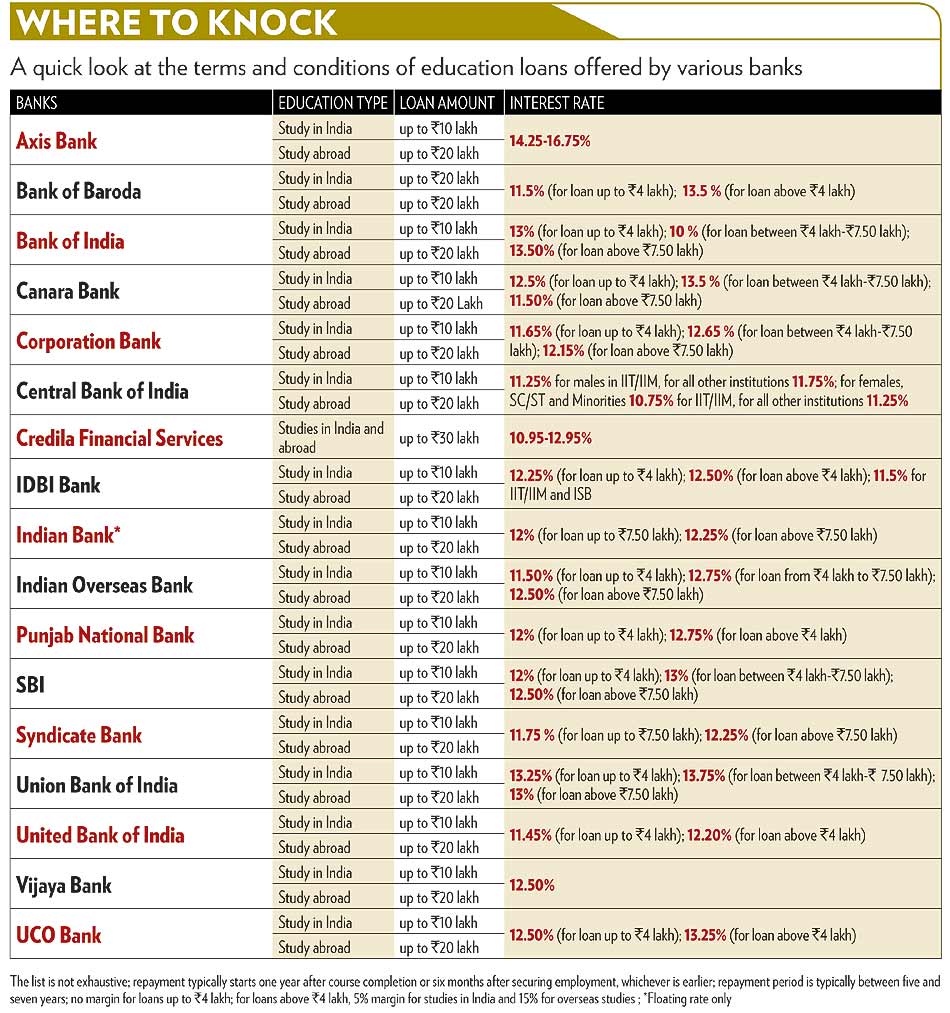
Margin money is the amount you need to fund through your own sources. Banks do not ask for any margin money for loans up to Rs 4 lakh. For loans above Rs 4 lakh, they seek margin money of 5 per cent of the total amount for study in India and 15 per cent for overseas study. On the collateral front, banks accept third-party guarantee for loans above Rs 4 lakh and up to Rs 7.5 lakh. For loans above Rs 7.5 lakh, they ask for tangible securities equivalent to 100 per cent of the loan amount as collateral, such as property, fixed deposits, bonds, and so on.


Pay interest to reduce cost
The time between the disbursal of the first instalment of the fee and the completion of the course is called moratorium. During this period, the bank charges a simple interest on the disbursed loan amount. Parents who have already squeezed their resources face a dilemma: whether to pay the interest during this moratorium period, or to let the interest accumulate so that the student can start repaying the whole amount when he/she gets a job.


For courses of long duration, such as 4-5 years, not servicing the interest during moratorium could prove costly as the accumulated interest can become a substantial amount. This would lead to an unnecessary burden on the student right at the start of his or her career. 


Says Bhonsle: “If you don’t pay the interest during moratorium, it gets accrued and compounded and the student may end up paying more over the entire tenure of the loan. Second, it is a very good way of building a positive credit history for getting future loans, such as two-wheeler, car, home and personal loans, at much better rates.” Also, it gives you a benefit of 1 per cent interest rate reduction.


Interest-free moratorium
There is some special cheer for meritorious students. The government of India has launched a scheme called ‘Education Loan Interest Subsidy Scheme’, especially designed to provide interest subsidy for the period of moratorium on educational loans taken by students from economically weaker sections. Under this scheme, you don’t have to pay any interest during your studies as it would be borne by the government. 


When you start repayment, you need to pay the original amount borrowed and the interest that will be charged only after moratorium.


The maximum loan limit under this scheme would be Rs 10 lakh. Says Niyogi: “Under this scheme, loans should be taken for pursuing higher technical/professional courses in India within the IBA Model Education Loan scheme. The gross parental income should not be more than Rs 4.5 lakh per annum. 


The scheme is for disbursements made during the 2009-10 academic year and onwards.” This subsidy will be available only to students enrolled in recognised technical/professional courses (after XII) in India in educational institutions established by Acts of Parliament, other institutions recognised by the concerned statutory bodies, IIMs and other institutions set up by the Central/state government. 


There would be a tag or marker on the degree and marksheet of the student indicating his repayment liabilities. An electronic tag will enable employers to identify loanees.


Stay on course of repayment
At the beginning of their careers, many students may not realise the importance of having a good credit history. They need to be sensitised about the need to repay the loan on a regular basis. Says Bhonsle: “We inform students that it (irregular payments) will make it extremely difficult for them to not only avail other loans, but also hamper their future employability if employers look into their credit record. On the contrary, if the repayment history is good, there are much higher chances of them getting other financial products at most attractive prices.”


Tax benefit
Education loans provide a tax-saving opportunity, both for the parent and the student under Section 80E of the Income Tax Act. Parents can enjoy tax benefits in the moratorium period during which they pay interest on the loan. After that, the student can avail unlimited tax benefit on the interest portion of the EMIs.


If used wisely, an education loan can really work as a facilitator to a bright future for you.